JOYLO VS BUBBLE
Joylo or Bubble.
Which one fits?
Joylo is an AI app builder with a named engineer in your codebase. Bubble is a no-code AI builder whose apps live in a visual programming language, not code. Bubble publishes no service where its own staff build your app. Joylo brings a certified engineer into your project for $500, covering 10 architect hours. The guarantee starts once you agree a scope and buy the recommended hours. Pick Joylo for the engineer. Pick Bubble for fully visual editing.
The short answer.
Four differences.
- Bubble publishes no staff build service.Every Bubble plan includes the Bubble Support Center. Hands-on building comes from independent experts in its marketplace, each handling its own scheduling and payments. Joylo's Expert Assist puts a certified engineer into your project for $500, covering 10 architect hours, with a 24-hour first response.
- Bubble app source code cannot be exported.Your data can leave as CSV or through Bubble's API, both on paid plans only. Moving off Bubble means rebuilding the application logic. Joylo generates React, Node and PostgreSQL that you can export to your own GitHub on every plan and run on AWS, Azure, GCP or your own infrastructure.
- Bubble meters usage in workload units.Starter, Growth and Team include a monthly allowance. Past it, you can buy a workload tier, pay overages as you go at $0.30 per 1K WU on the base plan, or switch overages off. Joylo's self-serve plans are a fixed monthly price with AI credits that reset each month.
- Fully visual editing is Bubble's real strength.The same Bubble editor builds the web app and native iOS and Android apps on one database, with the mobile builder in public beta. You change everything by drag and drop, from frontend design to backend logic. If that's how you want to work, pick Bubble.
Different jobs.
Not the same tool.
Bubble
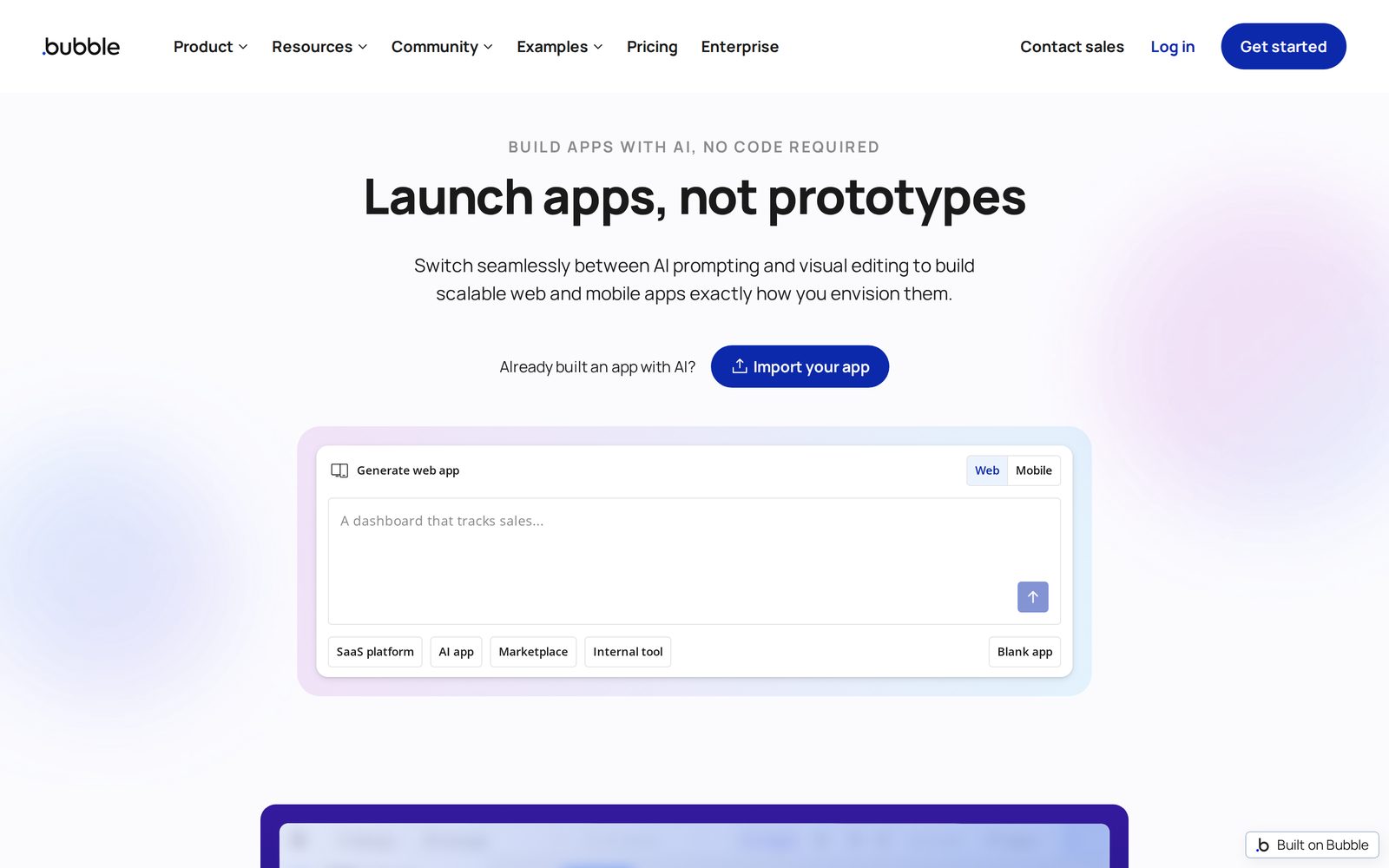
A no-code platform where the AI Agent drafts the app and you change it by drag and drop, from frontend design to backend logic. One editor builds the web app and native iOS and Android apps (mobile in public beta) on a shared database, and Bubble handles hosting and infrastructure. Its homepage lists 6M builders and 8K plugins.
Joylo
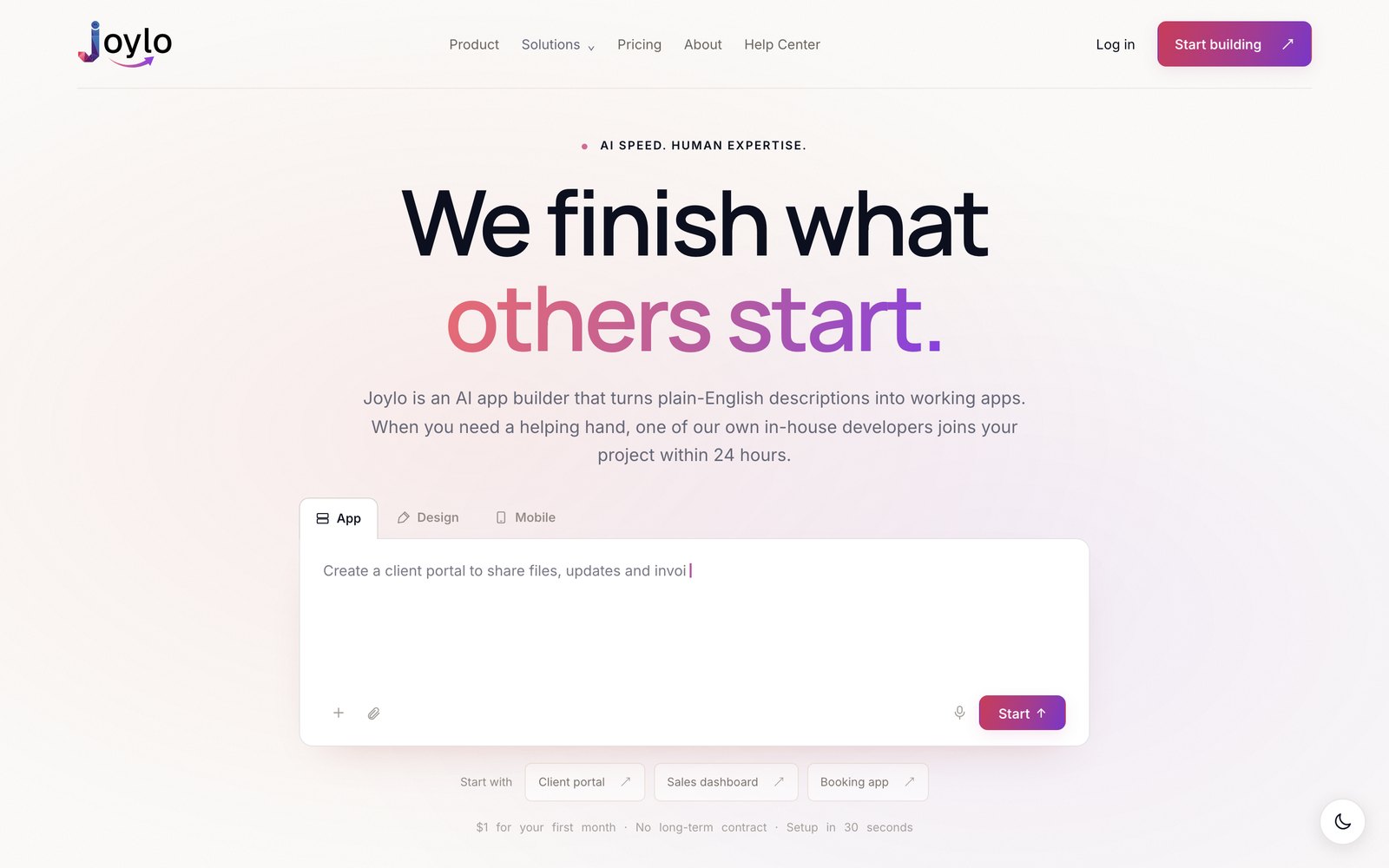
An AI builder that generates a conventional React front end, a Node API and a PostgreSQL database on Neon. The output is ordinary code you can export to your own GitHub and open in Cursor or VS Code. When the AI stalls, Expert Assist brings a certified Joylo engineer into the project for $500, covering 10 architect hours, so you are not the one debugging it.
So the split is not really builder against builder. It is whether you want code you can hand to any developer, or a visual app you change yourself that runs on Bubble. Decide that first and the rest of this page mostly answers itself.
How does Joylo pricing compare to Bubble?
Bubble's pricing page has two switches: a plan family (Web & Mobile, Web, or Mobile) and a billing switch labelled "Save up to 20% annually", which loads switched on. I checked all six combinations on Bubble's pricing page on 29 September 2026 and found a different Starter price in each. For web only, Starter is $29/month billed annually or $32/month billed monthly. For mobile only, it is $42/month billed annually or $49/month billed monthly.
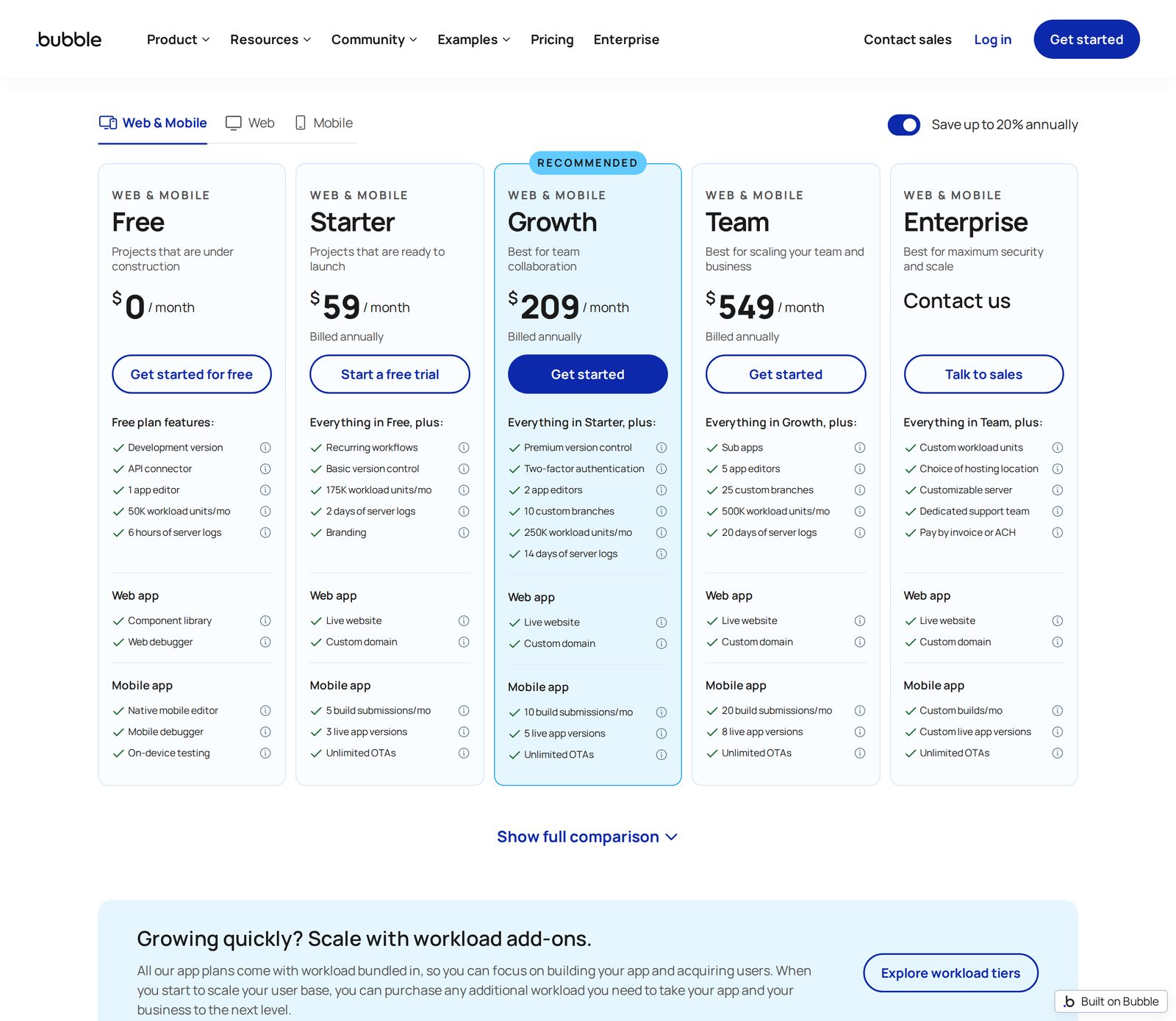
| Plan level | Joylo | Bubble |
|---|---|---|
| Trial | $1 for the first month | 14-day free trial of Starter, new apps only |
| Free | No free plan listed on joylo.ai/pricing | $0/month, every plan family and billing state |
| Entry paid | $25/mo (Solo Builder) | Starter, Web & Mobile: $59/month billed annually, $69/month billed monthly |
| Mid tier | $50/mo (Starter) | Growth, Web & Mobile: $209/month billed annually, $249/month billed monthly |
| Team plan | No Team plan listed on joylo.ai/pricing. Starter includes a team workspace and role-based access | Team, Web & Mobile: $549/month billed annually, $649/month billed monthly |
| Usage beyond the plan | Optional AI credit top-ups | $0.30 per 1K WU overage (Starter, Growth, Team), or workload tiers from $26/month billed annually ($29/month billed monthly) |
| Engineer capacity | $3,000 to $6,000/mo (Co-Build) | No Bubble-staffed build service published. Enterprise adds a Technical Success Manager, price not published. Independent agencies set their own prices |
| One-off engineer help | $500 for 10 architect hours (Expert Assist) | No fixed-price Bubble engineer help published. Independent experts set their own prices |
| Enterprise | Custom pricing, talk to us | Contact us |
In practice two rows decide it. The first is usage beyond the plan. Bubble meters it in workload units. It says workload "aggregates the server resources needed to host, run, and scale apps built on Bubble". Each plan includes a monthly allowance. Past it, Starter, Growth and Team can buy a workload tier or pay overages as you go. You can also switch overages off. The second is one-off engineer help. Bubble publishes no service where its own staff build your app. Its Technical Success Manager comes only with Enterprise. Enterprise has no published price. So if your worry is the week the build breaks, weigh that $500 against the week you'd otherwise spend fixing it yourself.
A named engineer.
When the AI gets stuck.
Joylo's Expert Assist costs $500 and covers 10 architect hours. A certified Joylo engineer works directly in your project, can see your codebase only once you approve access, and nothing merges without your approval. First response is within 24 hours. We investigate the cause and agree the right fix. If more work is needed, you see the recommendation before committing to more hours.
On Expert Assist it may not be the same engineer each time. Co-Build gives you a named engineer who knows your app from month to month. Joylo's written production guarantee begins once the scope is assessed, agreed, and the recommended hours are purchased.
Bubble's human help is real, so it is worth being exact about. Every Bubble plan, including Free, includes the Bubble Support Center. Bubble does not publish what that support covers, its hours or a response time. Enterprise adds a Dedicated Account Manager and a Technical Success Manager.
Hands-on building on Bubble comes from independent coaches, freelancers and agencies in its Experts marketplace, each handling its own scheduling and payments. So decide who does the work when the app breaks. On Joylo, it's one of our own engineers.
Code you own.
A stack you can move.
Joylo
A conventional React front end, a Node API and a PostgreSQL database on Neon, with no proprietary client SDK. Export the code to your own GitHub on every plan, from the $1 Trial up, run it on AWS, Azure, GCP or your own infrastructure, and open it in Cursor or VS Code. The database uses standard Postgres export and import tools, so the app is not tied to Joylo hosting.
Bubble
Bubble's manual says Bubble apps "can only be run on the Bubble platform; there's no way of exporting your application as code." Moving off means rebuilding the application logic, though Bubble says it can help export the design. You can take your data as CSV or through Bubble's API, both on paid plans. Bubble also pledges that if it ever shut down, it would release its source code under an open-source license so you could keep your app running. If you later want a developer to take the app somewhere else, check that constraint before you build on it.
Joylo vs Bubble: full feature comparison
Every cell comes from the vendor's own published pages, read on 30 September 2026. Nothing here is estimated.
| Feature | Joylo | Bubble |
|---|---|---|
| People and guarantees | ||
| Vendor's own engineer works in your app | Yes, Expert Assist, $500 for 10 architect hours | No Bubble-staffed build service published. Enterprise adds a Technical Success Manager |
| Help fixing or finishing your app | Yes, fix an issue, finish a feature or help you launch (Expert Assist) | Bubble Support Center on every plan, scope not published. Independent coaches, freelancers and agencies in Bubble's Experts marketplace, each handling its own scheduling and payments |
| Help with third-party integrations | Yes, integrations are covered by Expert Assist | Support scope not published. API Connector on every plan, including Free |
| Human engineer first-response SLA | 24 hours | Not published for the Support Center |
| Ongoing technical contact | Named engineer on Co-Build, from $3,000/mo | Technical Success Manager, Enterprise only |
| Marketplace of third-party experts | No. In-house engineers, not freelancers | Yes, vetted agencies, freelancers and coaches, each setting its own price |
| Service-level agreement (SLA) | Custom SLAs on Enterprise private cloud | 99.9% monthly uptime, Enterprise dedicated-server customers only |
| Building | ||
| How you build | Describe the app in plain English, the AI writes the code | AI Agent drafts the app, then drag-and-drop visual editing, frontend to backend |
| What the AI produces | React front end, Node API, Postgres via Neon | A visual app in Bubble's visual programming language, no traditional codebase |
| Full IDE / terminal access | Cursor, VS Code, or anywhere else | No traditional codebase to open |
| AI that changes an existing app | Yes, AI credits cover generating and changing your app | AI Agent (beta) builds and edits web and native mobile apps, rolling out to everyone |
| Mobile apps | Yes, mobile builds. The joylo.ai prompt box has a Mobile option | Yes, native iOS and Android on React Native, builder in public beta |
| App Store and Google Play publishing | For a mobile build in an agreed scope, Joylo engineers can prepare, sign and submit it. Apple and Google decide approval | Directly from Bubble, on paid Mobile or Web & Mobile plans only. Builds a month: 0 (Free), 5 (Starter), 10 (Growth), 20 (Team) |
| Version control | Included on every self-serve plan | Basic (Starter), Premium (Growth and up), with rollback |
| Pre-launch quality check | AI Confidence Score, five domains, every plan | Security dashboard flags exposed API keys and privacy rule gaps. Basic security tests: none (Free), 5 (Starter), unlimited (Growth and up) |
| Data | ||
| Built-in database | PostgreSQL via Neon, automatic backups | Built-in database, AI-generated schema with sample data |
| File storage | 5 GB (Trial, Solo Builder), 10 GB (Starter) | 0.5GB (Free), 50GB (Starter), 100GB (Growth), 1TB (Team, Enterprise) |
| Monthly usage allowance | AI credits: 100 (Solo Builder), 250 (Starter), no rollover | Workload units: 50K (Free), 175K (Starter), 250K (Growth), 500K (Team) |
| When the allowance runs out | New builds pause until the reset or a top-up. Live apps stay live | Overages at $0.30 per 1K WU (Starter, Growth, Team), lower on a workload tier. With overages disabled, the app goes offline once its included and workload-tier WU run out |
| Data export | Standard Postgres export and import tools | CSV or the Bubble API, neither on Free |
| Ownership and hosting | ||
| App source code export | Yes, to your own GitHub, every plan from the $1 Trial | No, "there's no way of exporting your application as code" |
| App logic export | The app's code, exported to your own GitHub | Not published. Moving off means rebuilding the application logic |
| Hosting and deployment | Hosting included in your monthly plan. You can also run your app on AWS, Azure, GCP or your own infrastructure | Bubble-hosted on AWS |
| Choice of hosting location | Private or public cloud with data sovereignty, Enterprise | Choice of hosting location, Enterprise |
| Leaving the platform | No proprietary client SDK, standard Postgres export | Rebuild the application logic, with Bubble's help to export the design |
| Migration in from other builders | Free standard migration from Lovable, Replit, Bolt and v0. Bubble is not named | App import in beta for a subset of users, designed for exports from Lovable, v0, Base44, Replit and Claude |
| Custom domain | Trial, Solo Builder and Starter | Starter and up, on Web and Web & Mobile plans |
| Teams, access and compliance | ||
| App editors | Team workspace on Starter | 1 (Free, Starter), 2 (Growth), 5 (Team), customizable (Enterprise) |
| Role-based access control | Yes, Starter, team workspace roles | Granular access permissions, plan-dependent |
| Compliance claim | GDPR-ready, enterprise-grade security | SOC 2 Type II and a GDPR DPA, every plan (Bubble's own stated claim) |
| Support hours | Engineers work 9am to 5pm GMT, Monday to Friday | Not published |
The takeaway from all 31 rows is that Bubble wins most rows about visual building, mobile and platform features, and Joylo wins the rows about an engineer working in your app, where Bubble's own help stops short of building the app. That is the trade, stated plainly: you are choosing between an all-in-one visual platform and an engineer you can bring into your code.
When is Bubble
the better choice?
- You never want to touch code.Bubble says it generates apps in a visual programming language "so you can understand and control everything without ever touching code". Drag-and-drop editing reaches from frontend design to backend logic.
- You need web and native mobile together.One Bubble editor builds the web app and native iOS and Android apps on one database. It publishes to the App Store and Google Play directly on a paid Mobile or Web & Mobile plan. The mobile builder is in public beta.
- You want one platform to run everything.Bubble includes the database, hosting, automatic scaling and one-click deployment, with a live app from Starter up. Its homepage lists 8K plugins, so there is little to stitch together yourself.
- You need SOC 2 Type II today.Bubble states it complies with the SOC 2 Type II standard and offers a GDPR data processing agreement. Joylo is GDPR-ready with enterprise-grade security.
Pick Bubble for any of those four and you will be happier than you would be on Joylo. That is not a flaw, it is a different job.
Who each one
is actually for.
Pick Joylo if
You are building something customers will pay for, you want code you can take to your own GitHub, and you want an engineer available the week it breaks. It fits first-time founders shipping a first real product, teams rescuing an app another AI builder left half-finished, and small teams with a roadmap and no engineering capacity.
Pick Bubble if
You want to build and change everything visually, you need web and native mobile apps on one database, and you are happy for Bubble to host and run the app. It fits founders who want to stay in no-code, agencies building client apps, and anyone who needs Bubble's own SOC 2 Type II compliance in place before you can sign anything.
Fair questions.
Straight answers.
The practical details before you choose.
Is Joylo more expensive than Bubble?
Not on the entry paid plans. Joylo's Solo Builder is $25/mo. If you build for web only, Bubble's Starter is $29/month billed annually or $32/month billed monthly. On the Web & Mobile plans it is $59/month billed annually or $69/month billed monthly, and workload tiers or overages can add to that. Bubble also has a $0 Free plan in every family and billing state. If you need an engineer, Joylo's Expert Assist is $500 for 10 architect hours.
Can I export my code from Bubble?
No. Bubble's manual says Bubble apps "can only be run on the Bubble platform; there's no way of exporting your application as code." You can export your data as CSV or through Bubble's API, both on paid plans, but moving off means rebuilding the application logic. Joylo exports the code to your own GitHub on every plan.
Does Bubble give me access to a human engineer?
Not a Bubble staff engineer who builds your app. Every Bubble plan includes the Bubble Support Center, but Bubble does not publish what it covers or a response time, and publishes no staff build service. Enterprise adds a Technical Success Manager. Hands-on building comes from independent experts and agencies. Joylo's Expert Assist puts a certified Joylo engineer into your project for $500, covering 10 architect hours.
How does Joylo's production guarantee work?
Joylo's guarantee is not automatic. We investigate the cause and agree the right fix. If more work is needed, you see the recommendation before committing to more hours. The guarantee begins once that scope is assessed, agreed, and the recommended hours are purchased. If our estimate falls short, we carry the extra engineering cost. Before that point there is no guarantee in force.
Can I move an app I built on Bubble into Joylo?
Joylo's site doesn't name Bubble for free migration. The joylo.ai pages I checked name Lovable, Replit, Bolt and v0 for free standard migration. Bubble's manual says there is no way of exporting a Bubble app as code, so its logic has to be rebuilt. To ask about a specific app, joylo.ai/pricing has a "Discuss your migration" option, with no price or outcome published for Bubble.
What are workload units on Bubble?
Bubble's pricing page says "Workload aggregates the server resources needed to host, run, and scale apps built on Bubble." Plans include 50K (Free) to 500K (Team) workload units a month. Past that, Starter, Growth and Team can buy a workload tier, which lowers the overage rate, or pay overages as you go at $0.30 per 1K WU, unless you disable them.
Is Bubble SOC 2 certified?
Bubble states it complies with the SOC 2 Type II standard for security and offers a GDPR-compliant data processing agreement, on every plan. Joylo describes itself as GDPR-ready with enterprise-grade security. If a certification is a procurement requirement, verify it directly with the vendor rather than from a comparison page.
What does Bubble's Starter plan actually cost?
Bubble's Starter price depends on two switches. On the Web & Mobile plans, Starter is $59 a month billed annually or $69 billed monthly. If you build for web only, Starter is $29 a month billed annually or $32 billed monthly. For mobile only, you pay $42 a month billed annually or $49 billed monthly. The pricing page loads on Web & Mobile with annual billing on, which is why $59 is the Starter price you see first.
Start building.
With someone to call.
Describe your app and see what you can build. No technical brief. No demo call.
Joylo prices in USD, excluding VAT where applicable. Engineers work 9am to 5pm GMT, Monday to Friday. Bubble figures are taken from Bubble's own published pages on 30 September 2026 and may have changed since.